Sunday, March 3, 2013

Not so casual games...

     This week we have dedicated to the very popular world of gaming and how to incorporate games into the second language classroom.  Gamification means taking parts or the underlying principals of games and applying them to non-traditional areas in order to increase engagement of participants.  Games can be used in language learning because games themselves have a unique way of engaging those using them.  In the following video, Tom Chatfield discusses many factors that are responsible for users intense engagement such as rewards, feedback and an element of uncertainty.  The type of game that I feel would be most beneficial from a language perspective are the "escape the room games".  In the game, Lost Cabin , a player must solve various puzzles to escape the log cabin.  I played the game 2 times and then got frustrated so I went to youtube and found the walk-through video which takes a player step by step through the game.
     I would use this game in a variety of ways and over 2-3 class periods during a unit on house vocabulary.

  1. I would use screen shots of various rooms in the house. Students would be required to label various items in Spanish in order to familiarize themselves with the vocabulary.  
  2. Next I would put students into groups and they would watch the walk-through video together.  Students would write down directions in Spanish as they are watching the video.  This way students have a step by step guide to win the game in Spanish.
  3. The next class period students would actually play the game. One partner designated as the player and the other as the director. 
  4. Students would play the game (without looking at the walkthrough) and if a student is stuck (in the target language) their partner will give them hints/tips to win the game. 
My learning objectives for this lesson are that the student is able to label house vocabulary as well as create directions in Spanish.  Students would be able to use informal commands in creating these directions.  I would serve as a helper when needed with directions or assist students that become frustrated.  After students are done and have successfully won the game, the next class period they would take a formative assessment in which I would use the same pictures from the game and students would need to label the relevant vocabulary.  This is only one way you could use an "escape the room game" with students.  It could also be used as a listening exercise.  

Sunday, February 24, 2013

Twitter...las posibilidades...

     For me, Twitter is a new technology experience that the majority of my students use daily.  On any given day, students will write "follow me @...." on my whiteboard, leaving their twitter handle for all to see.  I believe that Twitter is like a double edged sword because it can lead to endless possibilities for learning to happen; however, it can also function like Facebook and with teenagers this leads to conflicts.  In the article, A Must Have Guide On Using Twitter In Your Classroom, there are a list of various ways you can use Twitter for educational purposes which are broken down into the following categories: communication, organization, resources, writing skills, and twitter exercises.  Prior to the start of this semester I had thought about incorporating Twitter into my classroom and teaching because it is so widely used by my students.  Some possible ways of doing this are listed in the article such as using Twitter as a bulletin board, using it to keep students in the loop about assignments and instant feedback.  When I imagine using Twitter in my classroom I see it as a way to get my students to practice using Spanish outside the classroom.  I have even polled several classes and asked if their homework assignments were to follow me on Twitter and to respond to my Tweets would they.  Every time I ask this question I receive a huge "yes" from students.
     Another use of Twitter is to help me increase my network of resources and other educators.  I had never thought of using Twitter as a means of professional development until I started my account.  According to the article, A Great Cheat Sheet For Teachers, there are numerous hashtags specifically for educators.  These hashtags can help me filter the information I am looking at and also help me to send out specific information to my students if I choose to use Twitter in my classroom.  Within my first few days of using Twitter I started following another Spanish teacher from New Hampshire and she tweeted at me "Welcome to Twitter, the best professional development available".  That statement sums up Twitter for educators.  I believe you can use Twitter for two distinct functions, social or professional.  I can see how the social function can lead to undesired situations for educators/students, although, if Twitter is used appropriately for a professional growth function I think the possibilities are endless.  
  

Sunday, February 17, 2013

Social Networking...


I looked into a few different social networking sites but the one that seems to have the best information for me is Classroom20.  The first post I saw on the site was about using Twitter in the Spanish classroom.  This is an idea that I have been thinking about for a while now. It has great ideas regarding incorporating technology (such as tablets) into the everyday classroom.  I think this site will help me move my classroom away from the traditional and more into the 21st century.

A Learner Needs to be Like a Sieve

A Learner Needs to be Like a Sieve

     Social media has changed not only our society but also the way in which individuals process what is happening in society.  In the article, Connectivism: A Learning Theory for the Digital Age, George Siemens argues for a change in the way we perceive the act of learning.  He describe the change in the way which we measure knowledge and compares the past to the present.  In the past, knowledge has been measured in decades due to the slow development of information.  In today's society information development is rapid and at times information can be seen as outdated within a matter of months.  Due to this drastic shift he proposes we change our view of learning.  I believe that today's learns must act like sieves because on a daily basis we are bombarded with information/knowledge but it is our task to determine which is relevant or helpful to us.  Siemmens states, "The ability to draw distinctions between important and unimportant information is vital."  As a learner in the Digital Age we must make decisions about what information is unwanted material and what is necessary.  
     In his video, The Network is the Learning, he argues "the way we are connected...is largely responsible for how we stay current".  Staying current in our fields is of the utmost importance today.  Technology is changing everyday and it is being used in new ways, thus, we as the learners/users must adapt on a regular basis.  Additionally, in another video titled The Impact of Social Media on Learning, Siemmens discusses the idea of creating connections in order to promote conversations.  These conversations result in a growth in our own knowledge; however,  an individual learner must choose which knowledge to store and what to get rid of.  I believe that the best tool we can give our students is the ability to be critical thinkers about the information they are exposed to.  Learners must filter the information and knowledge gained by social software.   

Friday, February 8, 2013

Asking the important questions in the 21st century

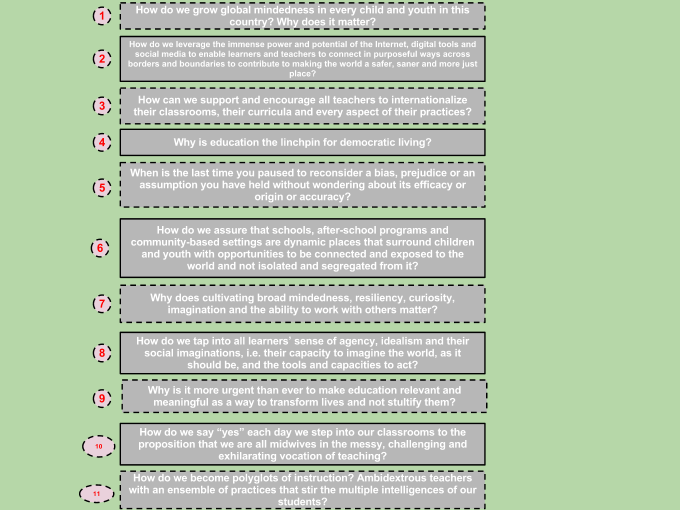
On my RSS feed I am following a blog called "Educational Technology and Mobile Learning".  It explores different ways to change the status quo in education by using technology and other 21st century literacies.  A post that I found particularly interesting is 12 Important Questions for 21st Century Teachers.  One question that really resonated with me is question number 7, "Why does cultivating broad mindedness, resiliency, curiosity, imagination and the ability to work with others matter?"  Multiple aspects of this question intrigue me, specifically the imagination and resiliency aspect.  Sometimes I feel that students have certain expectations, such as that they will all get into college and get a great paying job after graduation.  This is not a guarantee and I have seen many of my friends struggle to rebound after not getting into the college of their choice and or not getting any job offers.  If our students are going to survive in the 21st century work force they must be prepared to be resilient.  In my opinion, imagination goes hand in hand with resiliency because we need thinkers who are creative and don't get discouraged when they see a problem but get excited.  Without imagination we wouldn't have these technological advances I am using right now.  I think this post is great because it made me think and question my practices as an educator. 

Below is what I posted on the blog itself:

"I think this is a great list of questions that today's educators should ask themselves. I especially think question 7 is important because it addresses the importance of working with others in a collaborative setting.  Most jobs today require us to work with others regardless of how we feel about it.  My students often request to work individually instead of with their peers because they have an issue with a classmate. I am trying to teach them that to be successful in the 21st century - you MUST be a team member and be able to work as a group. Great post!"

Sunday, February 3, 2013

Did you see what she posted on Facebook?

     Now that I have provoked you into reading my latest post let's examine some of our favorite websites/networks and their connection with education.  It is clear that technology and social media are changing business practices and everyday life.  One area that seems unaffected is education.  In the video, Educational Change Challenge, Darren Cannell discusses this problem and challenges teachers to make a change.  He argues that if you took a teacher from a hundred years ago and placed them in a classroom today, the teacher would feel at home because nothing has changed.  Additionally, he states that educators must be relevant and innovative.  I agree with everything Mr. Cannell states but one factor he doesn't address is that sometimes teachers don't have the power to make significant changes.  Often enough those that make educational policies have never actually taught in a classroom, yet, they make policies and decisions that affect us educators.  Most teachers that I know and work with push educational boundaries everyday.  Teachers in my building have students create Animotos, complete webquests, use interactive websites to create media, create and publish videos on Youtube and much more.  These teachers have embraced the use of technology in education; however, at the end of the year we still must get our students to pass a standardized test.  Administrators tell us to be creative but mandate that we meet NYS Standards and get results on these outdated assessments.  I want to take on Mr. Cannell's challenge to change my classroom but many of the social media networks that my students use daily are off limits to educators.  I strongly believe that if schools/teachers utilize Facebook and Twitter in their classrooms we would be able to engage 99% of the students but like most schools, my administrator has said that Facebook is not an option.  As per the video, Social Media Revolution 2011, social media has taken over our society.  The video states that if Facebook were a country it would be the 3rd most populated in the world.  Sometimes I think teachers want to embrace the changes around us be feel handcuffed by the educational policies and expectations set by those not in the classroom.
     Another issue not addressed in either video is the necessity for technology and limited resources in many of today's schools.  You can't incorporate social media into your teaching if you don't have access to it.  Many schools struggle to keep relevant technology because of the expense.  In today's economy schools in WNY are laying off teachers by the handful.  So where does the money come from to by iPads for every classroom? People say they want education to change but when it comes down to raising taxes so that schools can buy the technology required, it is a different story.  Two things must happen for education to embrace the technological changes happening, equal/fair distribution of technology to all schools and a change in assessments.

Sunday, January 27, 2013

El uso de los Blogs...


Creating a blog is a new way that I can engage students, hold them accountable for their learning as well as grow as a second language teacher.  My students have grown up in the technology era and are constantly incorporating different technologies into their daily lives.  I need to incorporate this new type of literacy into my classroom in order to fully engage my students in the learning process.  Using a blog is a great way to meet various students' learning styles and needs.  Here are a few ways that I can utilize  my blog to meet the learning standards.  
  1. Post successful activities with reflections for other second language educators.
  2. Post photos, videos, songs or articles in that students must analyze and reflect on in Spanish. 
Collaboration is the key to success in education.  Through blogger, I can start following other second language educators around the world and gain critical knowledge of methods/techniques for second language acquisition.  I can also share activities/strategies that have worked within my classroom.  By creating a community of learners, I will grow as a teacher as well as challenge myself and students.  

My students struggle with the skill of description as well as writing complex sentences in Spanish.  Blogger will allow me to post photos of things they are interested in and require students to practice writing in the second language.  Through blogs, students will be using a literacy form they are familiar with and my hope is that they will be more willing to develop their writing in the second language.  Additionally, by using my blog I can challenge students to use critical thinking skills within the second language and teach them how to examine and synthesize in Spanish.   

The following NYS Standards for LOTE (Languages other than English) are being addressed:


  1. Students will be able to write brief analyses of more complex content when given the opportunity  for organization and advance preparation, though errors may occur more frequently.
  2. Students will be able to produce written narratives and expression of opinion about radio and television programs, newspaper and magazine articles, and selected stories, songs and literature of the target language.